 Trump Signal Index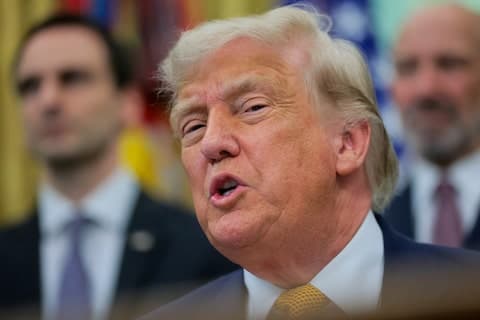
On June 22, 19 million barrels of crude oil transited the Strait of Hormuz — a single-day record. Trump posted about it on Truth Social the following morning alongside a broader status update: negotiations are smooth, Iran has agreed to unlimited nuclear inspections in perpetuity, oil prices are collapsing, the world is safer.
Iran’s foreign ministry told a different story at the same time. There were no IAEA meetings. No inspection protocol exists for Iran’s war-damaged nuclear facilities. No agreement of any kind has been signed on that subject.
Both governments are describing the same set of talks. The gap between their accounts is the central risk in this deal.
What Trump Said, Specifically
The Truth Social posts on June 23 contained three distinct claims:
On nuclear inspections: Iran agreed to “top-level nuclear inspections for a long time — ‘infinitely’” which will guarantee “nuclear transparency.” Trump added that without this concession, there would have been no further negotiations.
On Hormuz: The straits remain open. All US naval vessels remain in place. The probability of re-closure is “very low.” Trump also stated that the US, as “guardian angel” of the straits, could take 20% of all oil transiting — or collect tolls — if Iran fails to comply with the deal. The 60-day framework period is “just one option,” and after it ends Trump says he can “do everything I want.”
On frozen assets: Funds released by the US Treasury will be held in US-managed escrow accounts and used exclusively for humanitarian purchases — specifically US agricultural products: corn, wheat, and soybeans. Trump framed this as addressing an Iranian “humanitarian crisis.”
What Iran Said, Specifically
Iran’s foreign ministry spokesperson Esmail Baghaei pushed back on each element.
On the IAEA: “We have had no meetings with Director General Grossi. There are no plans for IAEA inspections of Iran’s war-damaged nuclear facilities. No relevant protocol exists.”
On frozen assets: The decision on how Iran uses its own released funds “will be made in the direction convenient and beneficial to the state.” On agriculture specifically: relevant ministries will decide based on price and quality. “There are no restrictions in this regard” — a formulation that neither accepts nor rejects the US escrow structure.
The IRGC-aligned outlet Tabnak went further, citing Trump’s Truth Social posts as evidence of “treaty violations by the head of the terrorist regime.”
The IAEA inspection dispute is not a minor discrepancy. It is the central unresolved question of the entire MOU framework. Iran’s nuclear program — the stated reason for the war — is either subject to unlimited permanent international monitoring (Trump’s claim) or the inspection framework has not been agreed at all (Iran’s claim). These cannot both be true. Markets are currently pricing Hormuz relief without a clear resolution on this question.
The Agricultural Escrow Structure Is a Trade Deal Hidden Inside a War Settlement
The escrow mechanism Trump described deserves attention that it has not received.
Two tranches of $6 billion in frozen Iranian assets ($12 billion total) are moving toward release. These funds are to be deposited in US-managed escrow accounts and designated exclusively for Iranian purchases of US food and medicine — with Trump specifically listing corn, wheat, and soybeans.
This is not humanitarian aid. It is a forced purchasing arrangement: Iran gets its money back, denominated in US-controlled accounts, redeemable only for US agricultural exports. American farmers — corn, wheat, and soybean producers — are embedded as direct beneficiaries of the settlement structure.
Iran’s foreign ministry implied it will not be bound by the restriction: “decisions will be made in the direction convenient to the state.” If Iran routes the escrow funds through third-party intermediaries to purchase non-US goods, the structure breaks down and the humanitarian framing collapses.
What Four Working Groups Reveal About How Long This Takes
The actual negotiating architecture disclosed by Iran’s Deputy Foreign Minister Gharibabadi at Luzern is more revealing than either side’s public statements.
Four working groups have been constituted: sanctions end, nuclear issues, reconstruction and economic development, and oversight and implementation. Each working group will report to a high-level committee chaired jointly by JD Vance, Iran’s parliament speaker Ghalibaf, and Foreign Minister Araghchi, with Pakistan and Qatar prime ministers participating.
Additionally, two standing bodies: a US-Iran liaison mechanism for Hormuz commercial shipping safety, and a four-party conflict-prevention body covering Lebanon (US, Iran, Qatar, Pakistan).
Working groups on sanctions, nuclear issues, reconstruction, and oversight — each with their own negotiating track — do not conclude in 60 days. The JCPOA, which was a less complex agreement in a less adversarial environment, took nearly two years to negotiate from the point of initial framework agreement to final text. What Trump is describing as smoothly proceeding is, structurally, the beginning of a multi-track negotiation that will run well past any 60-day clock.
The 60-day window Trump described as the current horizon for “free” Hormuz transit is not a deal deadline — it is the first phase of a multi-phase process. If working groups on nuclear issues and sanctions have not reached agreement by then, Trump’s stated options include Hormuz toll collection and military re-engagement. That threat is keeping pressure on Iran, but it also means the deal’s stability depends entirely on what happens in four simultaneous technical negotiations over the next two months.
Iran’s Diplomatic Counter-Moves
While talks continue, Iran’s leadership is actively building its own leverage through regional diplomacy.
President Pezeshkian visited Pakistan for a state visit, meeting Prime Minister Sharif, Army Chief General Munir (the real power center in Pakistan), and President Zardari. His message: the MOU should be implemented “fully within the framework of international law and the rights of the Iranian people.” Pakistan is a formal intermediary in the nuclear talks — Pezeshkian’s visit is about ensuring Islamabad remains a cooperative broker rather than a US-leaning one.
Parliament Speaker Ghalibaf and Foreign Minister Araghchi traveled to Oman simultaneously to discuss a new Hormuz management framework. Oman has historically been the back-channel for US-Iran contacts. A new Hormuz management protocol negotiated with Oman’s involvement would give Iran a degree of formalized standing in strait governance — something the US has explicitly not offered.
Hormuz transit (June 22)
19M barrels (record)
Frozen assets moving to release
$12B ($6B × 2 tranches)
IAEA inspection deal (US claim)
‘Unlimited, forever’
IAEA inspection deal (Iran claim)
‘No protocol exists’
Working groups constituted
4
60-day window status
Phase 1 of multi-phase process