 Trump Signal Index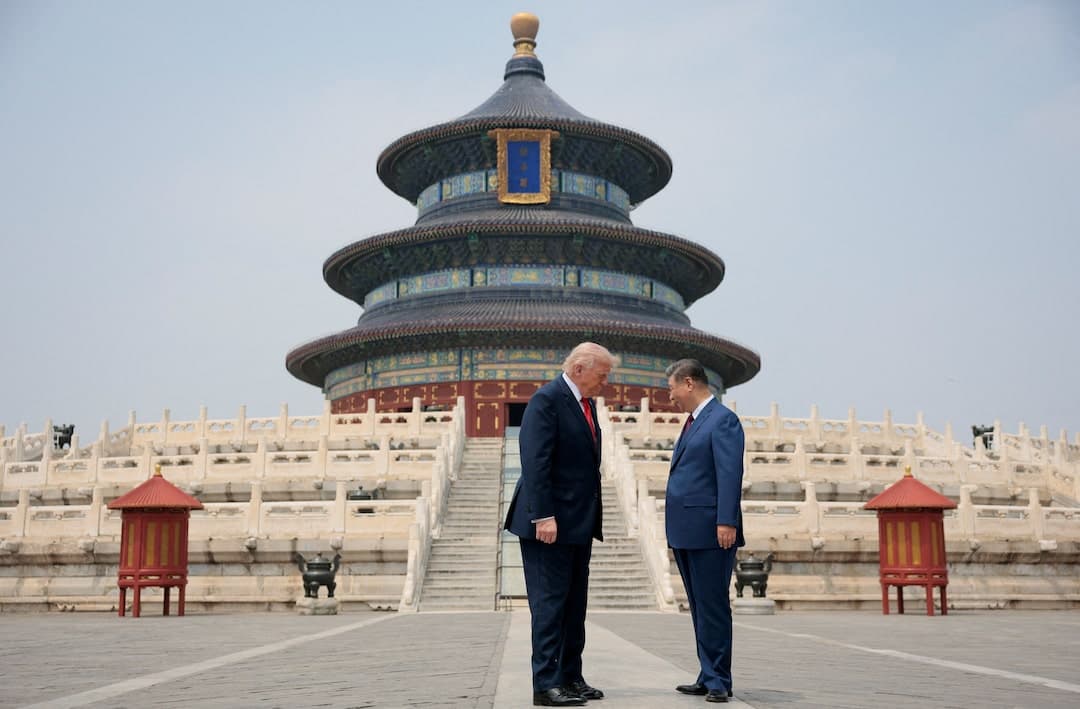
Trump and Xi met in Beijing on May 14 for 135 minutes. The atmosphere was described as warm. The two leaders walked through Tiantan (Temple of Heaven) Park and concluded the day with a state dinner.
No concrete agreement was announced. No joint statement was released.
Trump’s Beijing visit was his first since November 2017 — nearly nine years. The two leaders had last met in person at the APEC summit in Busan six months earlier. The accumulated agenda between them — semiconductor export controls, Taiwan, rare earths, Iran — filled 135 minutes of conversation. What it produced, publicly, was nothing.
What the Absence of a Joint Statement Signals
A joint statement is the minimum deliverable of a formal summit. Even vague language — “the two sides agreed on the importance of cooperation” — serves to set a diplomatic baseline. Not producing one is unusual.
Three readings are plausible.
First, the talks are still live. Publishing a joint statement locks in the negotiating perimeter. If both sides are still probing, silence preserves flexibility. The lack of a communiqué may mean the real discussions are ongoing, not that they failed.
Second, Taiwan was the real obstacle. The Trump administration has continued arms sales to Taiwan, which Beijing treats as a violation of the One China principle. If Xi demanded “Taiwan is China’s core interest” language in any joint document — and the US side refused — wrapping the summit without a statement is the cleanest exit for both.
Third, this is Trump’s negotiating style. Committing to paper sets expectations, and unmet expectations carry political costs. Keeping the outcome ambiguous preserves leverage. Trump walked away from the Hanoi summit with Kim Jong-un without a deal in 2019 for similar reasons.
The absence of a joint statement does not confirm failure. But it is not a signal that a deal is imminent either. Summits that conclude without a communiqué typically require weeks to months of follow-on technical work before outcomes are formalized.
Where Each Agenda Item Stands
Semiconductors. Jensen Huang’s inclusion in the delegation made AI chip export controls an implicit topic. No outcome means no carve-out — at least publicly. Nvidia’s China revenue collapsed from roughly $4B annually to near zero after the 2022 controls. H100 and A100 access remains restricted. Huawei’s Ascend 910B performs at approximately 60–65% of H100 capacity. If a chip deal was discussed, no framework was announced.
Taiwan. Both sides confirmed they discussed Taiwan. No content was disclosed. No confidence-building measures or hotline agreements were announced. The Strait of Hormuz crisis has absorbed US military bandwidth, but Taiwan Strait tensions — PLA naval exercises, airspace incursions — have continued at elevated frequency since early 2026.
Iran. China is Iran’s largest oil buyer, purchasing roughly 1.4 million barrels per day at discounted prices that sustain Tehran’s economy under US sanctions. Trump almost certainly raised the issue. Chinese pressure on Iran has historically influenced Iranian decision-making. No public commitment on Iran was part of the summit’s output.
Markets priced a 60–70% probability of a meaningful tariff pause and some form of export control review before the summit. A summit that ends without a joint statement forces a repricing of those expectations — particularly for semiconductor and China-exposed technology stocks.
The Counter-Argument: The Meeting Itself Is the Deliverable
Reading the summit as a failure may be premature.
The direct communication channel between Trump and Xi had been effectively closed for most of the second term. A nine-year gap between US presidential visits to Beijing, followed by a 135-minute in-person session, a park stroll, and a state dinner — in diplomatic terms, this is a serious attempt at relationship restoration.
In US-China history, substantive agreements have consistently emerged not from summits but from technical follow-on negotiations. Nixon’s 1972 Beijing visit produced the Shanghai Communiqué — but the framework it established took years to operationalize. The summit sets the tone. The deal, if it comes, comes later.
Xi’s domestic constraints are real. Agreeing to broad market opening under visible US pressure contradicts the Communist Party’s “dual circulation” and self-reliance narrative. Taking a photograph with Trump at a state dinner and signing a joint statement carry very different political costs domestically.
Market Implications
The gap between pre-summit expectations and actual output is the problem. The rally in technology stocks with China exposure — Nvidia, Apple, Qualcomm, Broadcom — was priced on “deal possible.” A summit that ends without a joint statement doesn’t confirm a deal is close.
Near-term pressure is likely on semiconductor names. Gold benefits from diplomatic uncertainty persisting. The key signal to watch: whether US Trade Representative-level or Treasury-level technical talks are scheduled within the next two to three weeks. That would confirm the summit was a successful opening. The absence of scheduled follow-on talks would confirm it was a photo opportunity.
The honest baseline: 135 minutes is enough time to explore, not enough to resolve. The deliverables, if they come, will come from the meetings that follow.
Summit duration
135 min
Previous in-person meeting
Oct 2025, Busan
Trump’s last Beijing visit
Nov 2017
Joint statement
None