 Trump Signal Index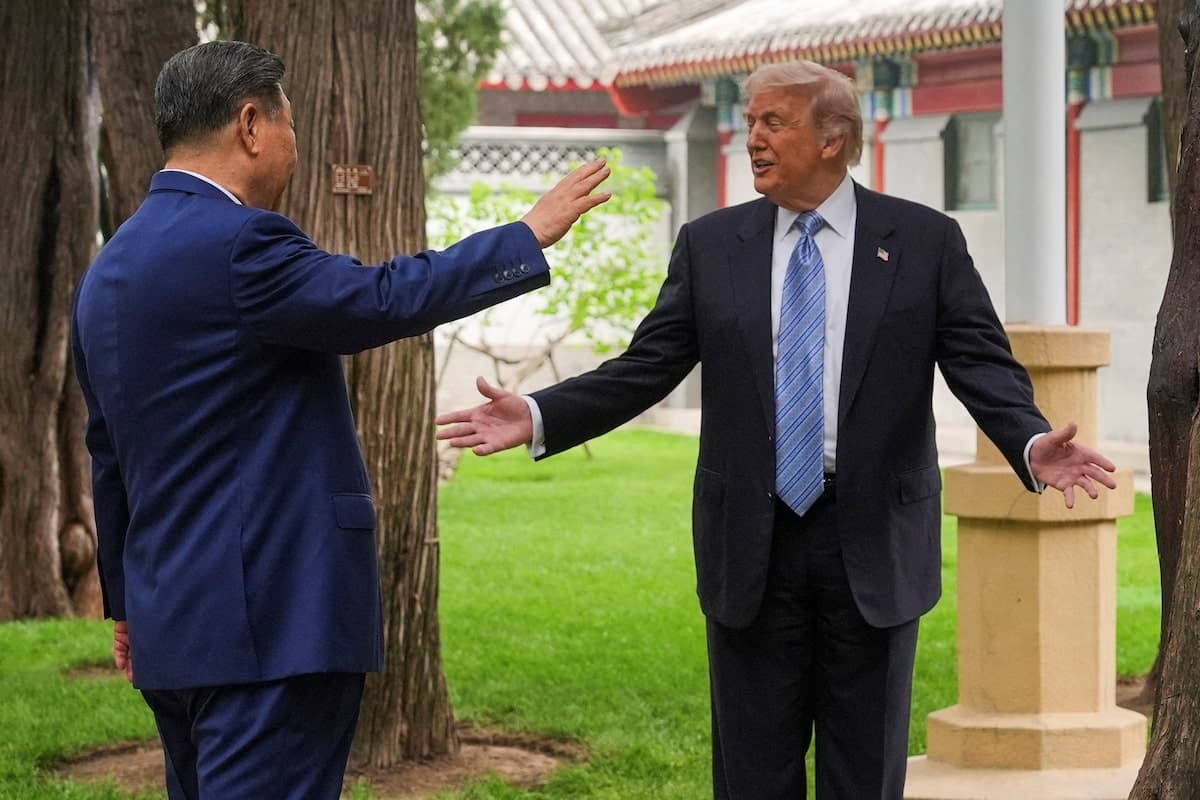
Before boarding Air Force One, every member of the US delegation threw away everything China had given them.
Credential badges. Delegation lanyards. Temporary phones issued for the visit. All of it went into trash bins at the departure point. NY Post White House correspondent Emily Goodin reported on X that staff were instructed nothing received in China would be permitted on the aircraft. No exceptions.
The security envelope extended further. Trump was advised to avoid using his personal phone throughout the Beijing stay. White House staff operated on disposable phones and temporary email accounts created for the trip. Personal electronics that could not be left behind were stored in Faraday bags — signal-blocking pouches that prevent GPS, Wi-Fi, and cellular transmission — inside Air Force One while the delegation was on Chinese soil.
What a Faraday Bag Protocol Actually Means
A Faraday bag is not a precaution taken against a theoretical adversary. It is a precaution taken against a confirmed one.
The US intelligence community has documented Chinese signals intelligence capabilities for decades. The NSA and CISA have both issued advisories on state-sponsored Chinese cyber operations targeting US government personnel and devices. The specific threat model for a presidential visit is device exploitation — the implantation of persistent firmware-level malware that survives a factory reset, enabling ongoing surveillance of communications, location data, and microphone input long after the target has returned home.
A credential badge or a temporary phone issued by the host government is a textbook vector for this kind of operation. The item is handled, it may contain embedded hardware or have been pre-configured with compromised software, and it travels back into the secure US government network unless discarded. The protocol the US delegation followed — discard everything, Faraday-bag everything else — is precisely what the threat model requires.
This is not unusual tradecraft for a visit to China. US government guidance for personnel traveling to China has included device hygiene protocols since at least 2018. What is notable is the scale: a full presidential delegation, including senior White House staff, operating under wartime-grade signals intelligence countermeasures while conducting a summit designed to project warmth and cooperation.
The Contradiction at the Center of the Summit
Trump and Xi walked through Tiantan Park. They held a state dinner. They spoke for 135 minutes about cooperation and the importance of bilateral stability.
The same day, US staff were stuffing Chinese-issued badges into trash cans and locking their phones in signal-blocking pouches.
Both things are true simultaneously, and the tension between them is not new — but it has rarely been this visible. Every major US-China diplomatic engagement since at least 2015 has been conducted under this dual reality: public warmth, private suspicion, institutional countermeasures running in the background. The Faraday bag protocol is not a sign that the summit failed. It is a sign of what the relationship actually is, regardless of what the summit produced.
The significance of Goodin’s reporting is not the security measures themselves — those are standard. It is that they are now public, attributed, and attached to a specific summit. Future Chinese counterparts reading this coverage understand that the US treats Chinese-provided materials as presumptively hostile hardware. Future US delegations understand that this posture has been confirmed publicly.
Why This Matters Beyond Symbolism
The signals intelligence dimension of US-China relations directly affects the space available for technology cooperation.
The same government that Faraday-bags its phones in Beijing is also deciding whether to ease AI chip export controls to Chinese companies. The same intelligence agencies that brief presidential delegations on Chinese surveillance capabilities are the ones that review export license applications for Nvidia H100 shipments. The operational security posture of the US delegation is downstream of the same threat assessments that drive semiconductor export policy.
A delegation that arrives in Beijing with burner phones and leaves with empty pockets is not a delegation whose government is close to trusting China with advanced AI compute infrastructure. The Faraday bag protocol and the chip export control regime are expressions of the same underlying judgment — that China’s intelligence services operate continuously and without restraint against US interests, including during summit handshakes.
The public confirmation of these protocols complicates the diplomatic framing of the summit. Beijing will register that the US has publicly characterized Chinese-issued credentials as potential surveillance hardware. That characterization, once on the record, is difficult to walk back in future negotiating contexts.
The Counter-Argument: This Is Standard Practice
Security professionals would correctly note that every US presidential foreign visit involves similar protocols. The State Department and NSS routinely issue guidance on device hygiene for any travel to a country with significant intelligence collection capabilities — which includes not only China but Russia, Iran, and several others.
The Faraday bag protocol is not specific to China. It is specific to adversarial intelligence environments. The fact that a US ally with comparable technical capabilities might warrant similar protocols — and does not receive the same public attention — reflects media asymmetry, not a unique policy targeting Beijing.
The counter-argument holds as far as it goes. But it does not resolve the contradiction. The question is not whether the protocols are standard. The question is what it means to conduct a summit — with a state dinner, a park stroll, and public statements about the importance of cooperation — under the assumption that the host is actively trying to compromise your communications.
The answer, in diplomatic practice, is: this is simply what great-power relations look like. Adversarial and cooperative simultaneously. The summit and the Faraday bags are not opposites. They are the same relationship, described from two different angles.
Items discarded pre-departure
All China-issued
Device protocol
Disposable phones + Faraday bags
Trump phone advisory
Avoid personal use
Email accounts
Temporary, trip-only