 Trump Signal Index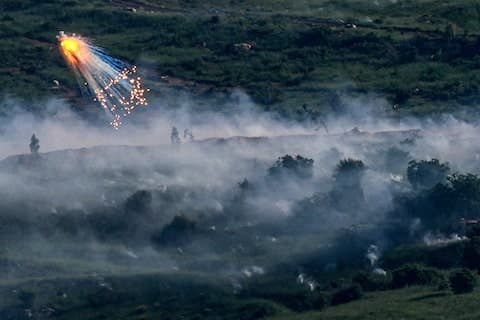
Five days into sustained US-Iran military exchange, July 15 produced two new thresholds.
First: CENTCOM struck coastal defense systems and cruise missile storage and launch facilities on Abu Musa Island — a disputed island inside the Strait of Hormuz that Iran has controlled since 1971. The operation ran approximately 90 minutes, completed at 7:30 AM EST, using precision-guided munitions. Separately, Iranian state media reported strikes near the port of Bandar Abbas, Qeshm Island, and Bandar Imam Khomeini. The Bushehr governor confirmed three US strike locations in Bushehr province — adjacent to Iran’s only civilian nuclear power plant.
Second: The IRGC issued a statement warning that “other oil and gas export routes benefiting the US and its allies” will be closed if the US continues its “piracy.” That language points directly at Saudi Aramco infrastructure, UAE pipeline routes, and other Gulf energy export mechanisms beyond Hormuz.
Both are new. The Abu Musa strikes move the conflict from Iranian mainland targets to forward-deployed strait-enforcement infrastructure. The Bushehr proximity, whether intentional or collateral, sends a signal about how close US targeting is willing to get to Iran’s nuclear assets. And the “other routes” threat, if carried out, transforms this from a Hormuz-specific crisis into a Gulf-wide energy infrastructure war.
Abu Musa: Striking the Strait’s Offensive Platform
Abu Musa and the Tunb Islands are the physical platform from which Iran projects force into the Strait of Hormuz. Cruise missile launch facilities there are not defensive assets — they are the offensive capacity that enables Iran to threaten merchant shipping without deploying from the mainland.
Striking them is categorically different from striking missile storage in Iran’s interior. It is a direct attempt to degrade Iran’s ability to execute the blockade from within the strait. CENTCOM’s statement was explicit: the strikes “further degraded Iran’s ability to threaten civilian shipping in the Strait of Hormuz.” This is enforcement-infrastructure targeting, not deterrence signaling.
Iran’s IRGC response — “Hormuz will remain blocked until US malign actions completely cease” — confirms the strikes have not changed Iran’s stated posture. The question is whether they have changed Iran’s operational capacity.
The Bushehr Proximity Signal
Strikes near Bushehr’s civilian nuclear plant carry significance independent of whether they targeted nuclear infrastructure directly. Iran’s Bushehr plant is the only civilian nuclear facility in the country and a politically charged symbol of Iran’s nuclear rights under the NPT.
US targeting in proximity to Bushehr — confirmed by the provincial governor — sends a message that the strike envelope is expanding geographically. Whether this was precision targeting of nearby military sites or deliberate proximity signaling, the effect is the same: Iran’s nuclear assets are now inside the contested zone in the public narrative.
This matters for escalation management in two ways. It raises the stakes for any Iranian decision to escalate toward its own nuclear posture. And it removes the implicit constraint that the US would keep targeting away from nuclear facilities — a constraint that had functioned as a de facto ceiling on the conflict.
The Bushehr proximity removes an implicit ceiling that had existed since the conflict began. Whether the US intended it as a signal or not, Iran and every regional actor will now price in the possibility that nuclear-adjacent facilities are targetable. That changes Iran’s internal escalation calculus, not just the external one.
Iran’s “Other Routes” Threat: The Abqaiq Scenario
The IRGC’s warning about “other oil and gas export routes” is the highest-stakes statement of the five-day conflict. The most direct reading: Saudi Aramco’s oil export infrastructure, UAE pipelines and terminals, and Qatar’s LNG export facilities are all now implicitly threatened.
The 2019 Abqaiq attack — attributed to Iran-aligned forces, targeting Saudi Arabia’s largest oil processing facility — briefly knocked out approximately 5% of global oil supply and produced the single largest daily oil price spike in history. Iran has the documented capability and precedent for this kind of strike.
A Hormuz blockade disrupts approximately 20% of global oil trade. Saudi infrastructure strikes would layer supply destruction on top of transit disruption. The combination would be a supply shock of a category not seen since the 1973 embargo.
The IRGC statement stops short of naming specific targets. But the logic is explicit: if the US blocks Iran’s ability to export through Hormuz by labeling it “piracy,” Iran will block everyone else’s ability to export too.
Regional Spread: Bahrain, Kuwait, Jordan
Iran’s retaliation on July 15 was not bilateral. The IRGC announced it targeted the US 5th Fleet in Bahrain. Kuwait intercepted Iranian attack drones. Jordan shot down three Iranian missiles. All three countries are US allies with existing basing agreements.
Bahrain is where CENTCOM’s naval headquarters is located — targeting the 5th Fleet directly is a significant escalation of Iranian intent, even if the missiles were intercepted. Kuwait and Jordan being drawn into the exchange signal that Iran is attempting to regionalize the conflict, forcing US partners to expend air defense resources and confront the domestic political cost of being in an active US-Iran war.
Bahrain’s military statement — describing Iran’s attacks as “criminal targeting of civilians” — is calibrated for international audience management. But the underlying message is that the conflict is no longer contained to Hormuz.
The “other routes” threat is the critical new variable. If Iran carries out strikes on Saudi or UAE energy infrastructure, oil markets face a supply shock scenario qualitatively different from a Hormuz transit disruption. Abqaiq 2019 produced a 15% single-day oil price spike under far lower geopolitical tension than currently exists. The Bushehr proximity strike removes a psychological ceiling on both sides. At day five with 30 confirmed Iranian military fatalities and no diplomatic channel, the trajectory has no visible floor. Oil, defense, gold, and shipping are fully live. Saudi/Gulf sovereign exposure is now a specific risk category.
Conflict Duration
Day 5
Abu Musa Strikes
Cruise missile + coastal defense sites
Bushehr
3 strike locations near nuclear plant
Iranian Fatalities
30 (5-day total)
Iranian Retaliation
Bahrain 5th Fleet, Kuwait, Jordan
IRGC Threat
All Gulf oil/gas routes to be closed