 Trump Signal Index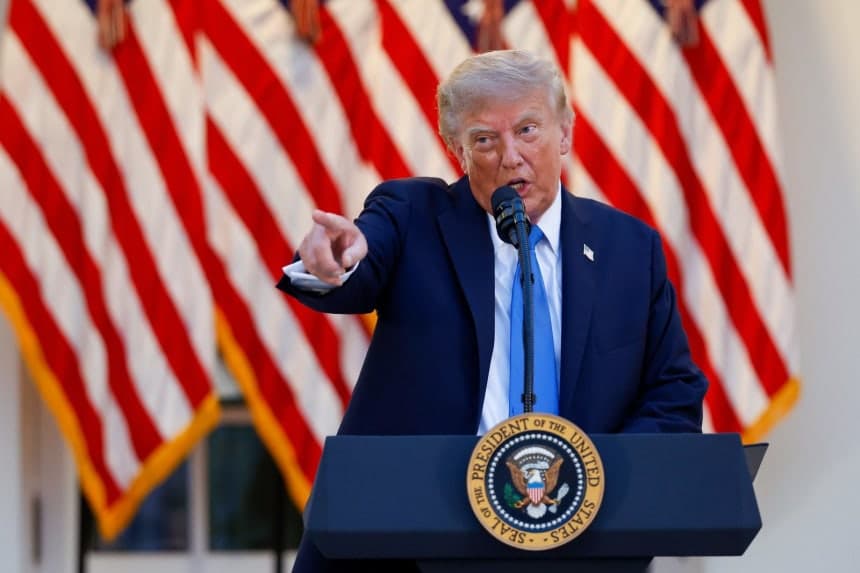
The Federal Reserve raised its benchmark rate by 25 basis points on September 16, to 3.75–4.00% — the first tightening move in three years and two months, and the first hike of the Warsh chairmanship.
The vote was 12–0. Every governor, every voting regional president — including Kevin Warsh, the chair Trump removed Jerome Powell to install, on the explicit expectation of cuts.
The Sentence That Should Not Exist
Trump's public response ran through the expected registers: the Board is "very hostile and very political"; the hike was aimed at him for "purely political reasons"; US rates should be "1% or lower" given "by far the best credit in the world"; and — in capitals — "LOWER THE RATES. HURRY!"
But the load-bearing sentence came on the tarmac in North Carolina, when he defended Warsh personally: "I trust Kevin, but he has a very difficult board. I told Kevin: it's useless anyway, so you might as well vote with the board."
Read it twice. As a defense of his chairman, it is an admission on two counts at once. First, that the president of the United States discusses and instructs the Fed chair's monetary policy vote — the thing the reported phone calls were suspected of and never confirmed, now confirmed by the president as a boast. Second, that the instruction was a concession of defeat: the chair he installed could not deliver the vote he wanted, so he authorized the surrender in advance and called it strategy.
This site wrote on September 1, when the 10-year hit a 19-month high: the event to watch was not the next inflation print but what Trump says the day after the FOMC actually raises. The answer is now on the record, and it resolves the year's central monetary question. The personnel lever is fully spent — Trump changed the chair, and the chair voted, unanimously with his colleagues, to tighten against him. What remains is pressure without a mechanism: the Board cannot be replaced before the midterms, the chair has demonstrated he will not defect from a unanimous committee, and the presidential channel to him is now publicly compromised by the president's own account of it. Twelve to zero is not a policy disagreement. It is an institution telling the White House it holds.
The Ultimatum Comes Due
The other clock started on September 4, when Trump declared that if the Fed didn't cut, he would stop trading with the countries the US runs deficits with. The Fed did not cut. It hiked, unanimously.
His post-hike statement re-upped the threat rather than executing it — with the number inflated again: halting trade with deficit countries would now earn "at least $1.5 trillion a year" (the September 4 version named Canada, Mexico, and the EU at a combined ~$485 billion; the arithmetic remains the same conflation of purchases with losses — "deficit," he wrote, "is just an elegant word for loss").
This is now a credibility test with a date attached. Either Section 338 proclamations against the EU or Mexico begin appearing — the Canada template exists and is active — or the market learns that the trade-halt ultimatum was noise, which discounts every subsequent threat in the series. Both outcomes move prices; only one of them is quiet.
What It Means for Markets
The honest reading of the hike itself cuts against the political noise: a unanimous FOMC defending the 2% target against maximum presidential pressure is precisely the demonstration of independence that the long end of the curve has spent months pricing the absence of.
Watch the 30-year, not the front end. The 55-days-above-5% story on the long bond was substantially an independence premium — compensation for the risk that policy would eventually be set politically. A 12-0 hike over explicit presidential objection is the strongest counter-evidence that risk has received all year, and some compression of that premium is the rational response even as the front end reprices higher. The dollar gets both channels: higher rates and demonstrated credibility. Gold loses its Fed-capture bid, though the fiscal side ($5,000 dividends, $40T debt) keeps a floor under it. The unresolved risks are two: the ultimatum — any Section 338 move against the EU or Mexico converts a monetary story back into a trade shock — and the Board itself, because "hostile and political" from this White House has historically been a targeting designation, not a description. The next chapter is whether pressure moves from the chair he can't move to the governors he might: watch for resignation pressure, IG referrals, or structural proposals aimed at the Board. The institution held. The question is what gets aimed at it next.
The Decision
+25bp to 3.75-4.00% — first hike in 3 years 2 months
The Vote
12-0, Warsh included — first hike of the chairmanship Trump created
The Confession
'I told Kevin: it's useless anyway, vote with the board'
The Attack
Board is 'very hostile and very political'; hike was aimed at him
The Demand
'1% or lower' — 'LOWER THE RATES. HURRY!'
The Ultimatum
Sept 4: no cut = trade halt. No cut happened. Claim now '$1.5T a year'