 Trump Signal Index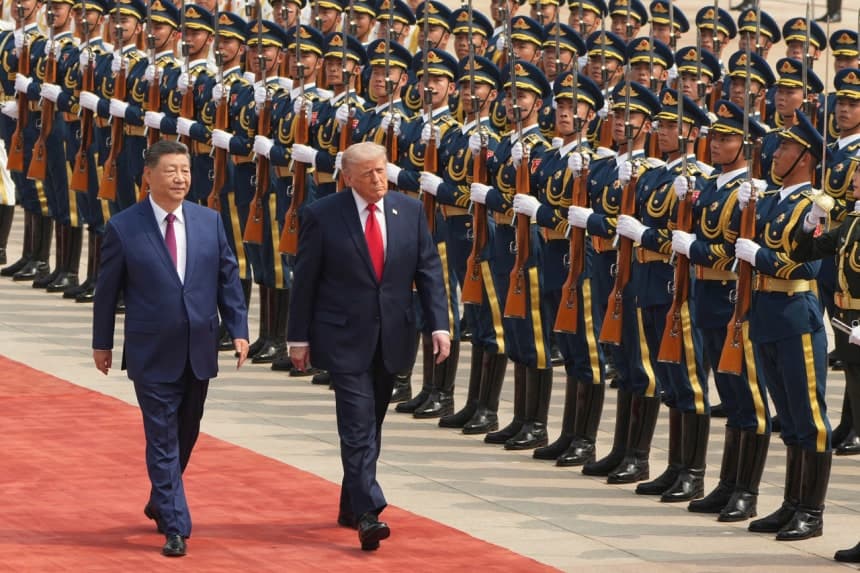
Xi Jinping arrives in the United States today for a state visit, and Trump will be on the tarmac at Joint Base Andrews to meet him — a gesture neither leader has made for a foreign counterpart before. Xi has never greeted a visiting leader at an airport since taking power.
“It’s going to be a great meeting,” Trump told reporters at the UN General Assembly. “We have a very good relationship.”
The Washington Post’s preview of the week put it plainly: this is a tightly choreographed summit designed to preserve a fragile truce between the two powers, weighted toward ceremony and relationship management rather than concrete results.
The Staging
The production schedule for September 24 reads like a coronation:
- An official White House arrival ceremony with roughly 480 US service members
- Both national anthems, and a flyover by one B-2 Spirit and four F-22 Raptors
- A state dinner whose guest list includes Jeff Bezos, Elon Musk, Sundar Pichai, Jensen Huang, and Sam Altman
The dinner list is the part to read closely. Those five people run the companies that sit at the center of every live US-China dispute: AI models, advanced chips, cloud infrastructure, satellite networks, and EVs. Seating them across from Xi turns the state dinner into the one room where the commercial terms of the rivalry are visible — and it follows Trump’s statement last week that Chinese automakers building plants in America would be “fine.”
Both leaders are buying the same product, and it is the image itself. Georgetown’s Evan Medeiros frames it as mutual time-buying: each side reducing vulnerabilities while projecting strength. For Xi — heading into next year’s party congress and a fourth term, after a year of military and government purges — a full state visit with an American president on the tarmac certifies China as America’s equal, at home and abroad. For Trump, six weeks before the midterms, it produces the picture of a leader managing the world’s most important relationship without a crisis. When both parties want the same photograph, the photograph is guaranteed. The substance is what gets deferred.
The Substance Is Thin by Design
The top agenda item is modest: extending the trade truce that expires in November. Chip export licenses, export controls, and AI are also on the list, but the consensus expectation is no breakthrough on any of the rivalry’s core disputes.
Two process details explain why. Preparation was unusually short. And the US agenda was reportedly shaped by Treasury Secretary Scott Bessent rather than the State Department or the National Security Council — which frames the meeting as an economic transaction to be managed, not a strategic relationship to be negotiated. Taiwan, arms sales, and the Iran leverage question sit outside a Treasury-led frame by construction.
With two more Trump-Xi meetings already scheduled for November and December, the incentive to settle anything hard this week is close to zero.
What Trump Admires
The Post’s sourcing adds a revealing layer. Trump has shown sustained interest in Chinese state spectacle — after seeing the Great Hall of the People in Beijing in May, he said in August he wanted a grand banquet hall for the White House. Experts quoted by the Post read something beyond architecture into it: Trump sees in Xi the power to push through domestic opposition, at a moment when his own building projects and policies keep running into American courts.
That observation lands differently in the week the White House barred CNN and Politico and the president described AI-safety critics as traitors. The admiration is not for China’s economy or military. It is for a system where the leader’s decisions are not checked.
The base case is benign for markets and should be priced that way: a truce extension is the most likely deliverable, which removes a November cliff for tariff-exposed sectors and keeps chip export policy on its current track — mildly supportive for semis and China-exposed multinationals. The dinner list is a tell worth watching for follow-through: any announcement touching Nvidia export licenses, Tesla or BYD manufacturing, or AI cooperation would move individual names more than the summit communiqué moves indices. The tail is Taiwan: a Treasury-led summit is structurally unlikely to trade on Taiwan, but any joint language shifting from “not support” to “oppose” independence — or a quiet extension of the arms-sale pause — would be the one outcome that reprices regional risk. Read the statements for vocabulary, not the flyover for signal.
Arrival
Sept 23, Joint Base Andrews — Trump greets Xi on the tarmac
The Ceremony
~480 troops; one B-2 and four F-22s overhead
The Dinner
Bezos, Musk, Pichai, Jensen Huang, Sam Altman
Top Agenda
Extending the US-China trade truce that expires in November
Who Set It
Treasury Secretary Bessent — not State or the NSC
Expectation
No breakthrough on chips, export controls, or AI; Nov and Dec meetings already set