 Trump Signal Index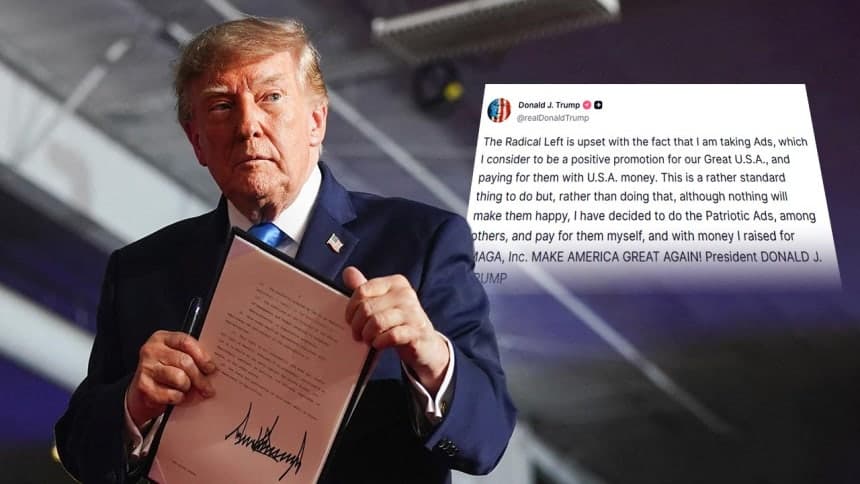
On October 5, Trump announced a change in who pays for the ads about him.
“The Radical Left is upset” that he was running ads he considers “a positive promotion for our Great U.S.A.” and paying for them with “U.S.A. money,” he posted on Truth Social. That, he said, is “a rather standard thing to do.” But he has decided to pay for the “Patriotic Ads” himself, “and with money I raised for MAGA, Inc.”
What Was Spent
- Ads: At least 13 video ads promoting the president and his policies, produced by the administration through last week, according to CNN
- Cost: At least $10.1 million in taxpayer money so far, according to ad-tracking firm AdImpact
- The objection: Government watchdog groups say the ads may break laws that bar federal funds from being used for partisan publicity or propaganda
Trump did not concede that point. His post defends the past spending as normal and changes only the funding going forward.
Where the Money Comes From Now
The new source is named in the post: MAGA Inc, the super PAC that has raised roughly $1 billion this cycle. Super PACs are legally independent of candidates. Trump has described this one, in his own words, as “my money that I control.”
So the ads move from the Treasury to a political committee — which is where campaign-style ads belong. But the line between “government promotion of the U.S.A.” and “campaign advertising for the president’s party” was the question the watchdogs raised, and the post answers it by moving the bill, not by drawing the line.
The reversal is about timing more than principle. Four weeks before an election Trump has framed as a referendum on himself — “I am the candidate on this ballot” — a story about taxpayers funding ads for the president is costly, and moving the ads to MAGA Inc ends it cheaply. Nothing about the $10.1 million already spent changes, and the post insists that spending was standard. The pattern matches the administration’s approach to other limits this fall: a court order on press access answered with a workaround, a $927 million renovation Congress largely did not approve. Each time, the action continues and only the mechanism shifts. It is also exactly the behavior the Democrats’ post-midterm bills on presidential self-dealing are written to target.
The Other Side
Administrations of both parties have paid for public-information campaigns — health enrollment, census participation, public-safety messages. Promoting government programs is legal; the question is whether a given ad crosses into partisan or personal promotion, and that is a judgment the watchdogs’ complaints will have to make case by case. The amounts here are small relative to the federal budget. And Trump has now done what critics asked: stopped using federal money for the ads.
There is no direct market trade here. The relevance is political. The ad reversal is a small retreat that signals the White House is reading the polls — Democrats lead the generic ballot by 7 to 10 points — and trimming vulnerabilities before November 3. Money moving into MAGA Inc also means more of the super PAC’s roughly $1 billion will show up in the final weeks, which raises the volume of Trump-centered messaging in close races. For markets, the useful signal is the trend in those races, because control of Congress decides the fate of the $5,000 dividend pledge and the oversight fights over the tariff program’s emergency-power footing. Watch for a Government Accountability Office or inspector-general review of the $10.1 million. A finding that the ads were illegal propaganda would hand Democrats a ready-made oversight case for January.
Taxpayer Ads
At least 13 videos promoting the president and his policies (CNN)
Cost So Far
At least $10.1 million (AdImpact)
Trump’s Defense
Funding them with ‘U.S.A. money’ is ‘a rather standard thing to do’
The Change
Future ‘Patriotic Ads’ paid by Trump and ‘money I raised for MAGA, Inc.’
The Concern
Possible breach of laws barring federal funds for partisan publicity
Watch
Any GAO or inspector-general review of the spending