 Trump Signal Index
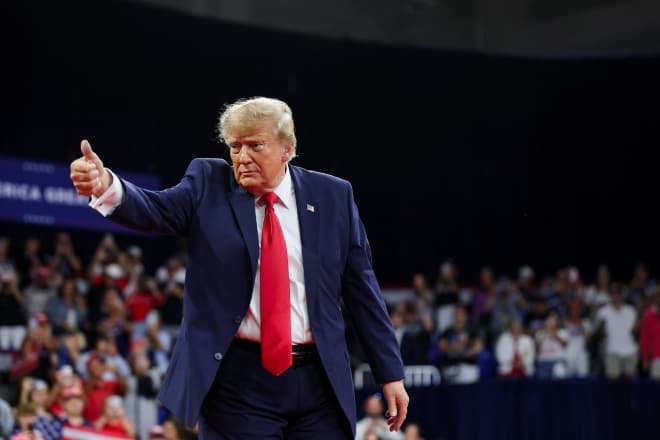
Leaving the White House on October 23, Trump was asked what happens if the midterms produce gridlock. He said he thinks Republicans will win. But if there is gridlock, he said, he will veto every bill.
Then, he said, Democrats will come to negotiate. He will veto, and veto, and veto again, until they ask what they have to do to get a bill passed. And then they will make a deal.
Democrats have already drafted the bills they want to pass after a win: limits on emergency powers, a ban on taking foreign government money without Congress, civil service protections. Trump has now said what happens to them.
The Math
A vetoed bill becomes law only if two-thirds of the members present and voting in each chamber vote to override.
| Chamber | Seats | Needed to override (full attendance) | On the ballot Nov 3 |
|---|---|---|---|
| House | 435 | 290 | All 435 |
| Senate | 100 | 67 | 35 |
Democrats lead the generic House ballot by about 7 to 10 points, and the Senate, where Republicans hold 53 seats, is close. Even a wave would leave Democrats far short of 290 and 67. An override needs a large bloc of Republicans to break with Trump.
For scale: after Watergate, Democrats held 291 House seats and 61 in the Senate. That House had one seat more than an override needs at full attendance. Nobody expects margins like that in November.
The Record
Trump has already shown how this works with a Republican Congress.
- The two vetoes: Late last year he vetoed two bills that had passed with bipartisan support. One would finish the Arkansas Valley Conduit, a drinking water pipeline in Colorado. The other amended the law on the Miccosukee reserved area in Florida, for flood protection on tribal land.
- The override votes: On January 8 the House voted 248 and 236 to override. Some Republicans joined Democrats. Both votes fell short of two-thirds.
- The unsigned bill: In July he refused to sign a housing supply bill while pressing Congress to pass election legislation he wanted. He did not veto it. Under the Constitution, a bill the president holds for ten days, Sundays excepted, while Congress is in session becomes law without his signature, and it did on July 11.
In his first term Trump vetoed ten bills. Congress overrode one: the annual defense authorization, in January 2021.
What a Veto Can’t Stop
A veto blocks laws. It does not block the rest of Congress’s power.
- A Democratic House would control committees and subpoenas, with hearings and document demands aimed at the administration. Trump has warned for months that a Republican loss means impeachment.
- A Democratic Senate could refuse to confirm federal judges, senior officials, and ambassadors.
- Must-pass bills cut both ways. Next year’s budget and debt-limit negotiations are expected to be the main collision points. If Democrats attach policy demands and Trump answers with vetoes, the risk of a government shutdown rises. The October–November 2025 shutdown lasted 43 days, the longest on record.
A president who cannot pass laws but cannot be overridden governs by executive action. That is already how this month has gone: the Russian diesel license, the Graham sanctions waiver, and the Canada tariff reshuffle were all signed without Congress. A Democratic Congress could pass bills to reverse them, and Trump’s veto would most likely stand. So the fight would move to the places a veto does not reach — oversight, confirmations, and the budget — and the bargaining chip would be whatever Congress must pass. If there is one issue where a two-thirds coalition might exist, it is Russia. The Graham law passed by an overwhelming margin, and Republican Senate candidates have already broken with Trump over the waiver.
The Other Side
Presidents facing an opposition Congress routinely use the veto as leverage, and Trump’s description — veto until they negotiate, then deal — is how divided government usually ends up working. The line was also a pre-election message aimed at his own voters, delivered alongside a prediction that Republicans will win. A common view on Wall Street is that divided government is good for markets because it limits large policy swings in either direction. And a deal-making veto strategy could produce more bipartisan bills, not fewer.
For markets, the line sets the template for a Democratic win: no major new laws in either direction, more policy by executive action, and the leverage concentrated in deadlines. Executive actions on tariffs, sanctions, and energy would stay as easy to change as they are now, which keeps that policy volatility in place. The dates to watch next year are budget deadlines and the debt limit, where a veto standoff becomes shutdown risk and, in the worst case, Treasury market stress. Senate control also decides confirmations, including any Federal Reserve nominees. If Republicans keep both chambers, none of this applies, and the $5,000 Trump Dividend and other promises tied to a Republican Congress come back into play.
Trump (Oct 23)
If there is gridlock, he will veto every bill until Democrats deal
Override Threshold
Two-thirds of each chamber: 290 House, 67 Senate at full attendance
Nov 3 Ballot
All 435 House seats; 35 Senate seats
Recent Vetoes
Two bipartisan bills; Jan 8 override votes 248 and 236, short of two-thirds
First Term
10 vetoes, 1 overridden (defense bill, Jan 2021)
What a Veto Can’t Stop
House investigations; Senate confirmations; shutdown leverage